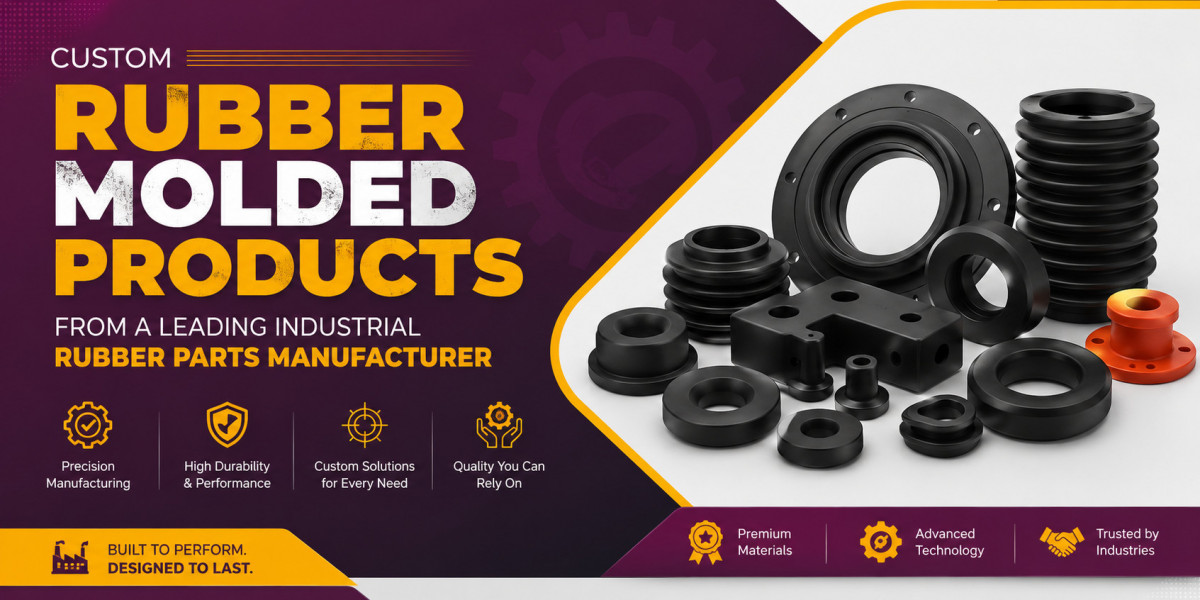

In the world of industrial manufacturing, custom rubber molded products are the unsung heroes that keep critical systems running smoothly. These precision-engineered products help shield sensitive equipment; they reduce vibrations, form a seal against contaminants, and they even help with thermal expansion across lots of different uses.
The gap between a standard part and a truly custom-engineered solution can be the difference between machinery working optimally and just dealing with premature failure over time. This guide digs into what makes truly outstanding rubber molding capabilities different and why, also what actually goes on during the process, and why it matters so much to partner with a specialized industrial rubber parts manufacturer—so you can count on solid results even in tough environments.
What is Rubber Molding
Rubber molding is an advanced manufacturing approach that turns raw elastomer compounds into accurate components using heat and pressure. It usually starts with designing a custom rubber mold, which basically becomes the roadmap for each subsequent part. That tool, often machined from steel or aluminum, locks in the final geometry as well as the surface feel of the finished component.
Then the rubber compound is introduced; it is a thoughtfully formulated blend of base polymers like silicone, EPDM, or nitrile plus curing agents and fillers. After that, the material is placed into the custom rubber mold, and vulcanization is used, which is where the magic chemical reaction happens.
Factors for Custom Rubber Mold Development
Making a custom rubber mold that actually works takes more than just “pick a rubber and go.” You need material knowledge, proper tooling design, and manufacturing knowledge, kind of all at once, even if it gets a bit complicated in real life. A rubber mold manufacturer has to think through several things, like:
- Material choice depends on where the part will live, such as temperature swings, chemical contact, and the mechanical load it will face.
- Dimensional tolerances and shape requirements, these have to line up with references such as ISO 3302-1 for dimensional tolerances of molded rubber products.
- Production volume needs, because that basically decides if compression, transfer, or injection molding is the sensible route.
- Part geometry difficulty, including undercuts, insert placement, and even multiple durometers in one build.
- Cost balancing, tooling budget vs the cost per part once you’re making it for real, steady and repeatable.
Compression Molding: Reliable for Many Uses
Compression molding is still one of the most used ways to make rubber molded products, especially for bigger parts and moderate production volume. The process is simple in description but not always simple in practice: you put a pre-formed rubber compound right into the open mold cavity. Then the mold closes with pressure, the rubber spreads to match the cavity, while heat starts vulcanization.
Compression molding brings notable benefits: low tooling expenses, less scrap material, and the capability to work with high-durometer materials and thicker cross-sections. The downside is that cycle times can run longer than in injection molding because heat transfer is slower, especially in thicker areas.
So, compression molding often fits parts needing longer curing, or runs that are low to medium.
Injection Molding: Accuracy and Speed for Larger Output
When you’re talking about high-volume custom injection-molded plastic parts and also certain rubber components, injection molding is usually the faster, more precise option. In this method, the rubber compound is heated, then injected under high pressure into a closed mold cavity. The upside is clear: much quicker cycle times, tighter dimensional tolerances, less flash, and very repeatable part-to-part consistency.
Injection molding is excellent for high quantities of smaller to mid-sized parts, and it can also handle bonded metal inserts. You can make intricate geometries with high reproducibility, too. The initial tooling cost tends to be higher than that of compression molding, but for big manufacturing runs, the lower per-unit cost and the production speed make it the more practical decision.
Quality Assurance and Industry Standards
Solid rubber molded product manufacturers often stick to strict quality standards, and that keeps the performance kind of steady, plus it boosts reliability too. You’ll see things like ISO 9001 and auto-related certifications such as IATF 16949, which reflect a structured quality management way of thinking.
For testing routines, they typically look at tensile strength, compression set, hardness, and also how the rubber resists the real-world environmental side of things. On top of that, dimensional checks confirm each component meets its tolerance targets, but they also keep material traceability logs that follow the work from incoming raw material all the way to final dispatch or delivery.
In practice, a well-known industrial rubber components manufacturer keeps these systems running, so customers receive parts that stand up across the expected service life span.
Common Applications and Product Types
Custom rubber molded products show up in an unusually wide list of industries because the material properties are useful in so many situations. Automotive systems include engine mounts, suspension bushings, seals, gaskets, and vibration dampeners that help with ride comfort and durability.
Industrial equipment uses rubber bellows, expansion joints, diaphragms, and protective covers that guard delicate mechanisms from contamination. The aerospace field often requires precision-molded seals and isolators to manage extreme temperature shifts and pressure differences.
For electronics, you’ll see grommets, keypad components, and insulating parts that reduce shock risk and protect against environmental ingress. KRISHANI PRODUCT DEVELOPMENT supplies these kinds of components with steady quality, plus disciplined precision engineering.
The KRISHANI Advantage
KRISHANI is known as a dependable rubber mold manufacturer, helping customers across North America with solid local knowledge. They handle the whole journey, from concept design and prototyping to tooling, sampling, and even the final production part. That whole end-to-end flow makes the communication smoother, and quality control stays tight through every single step.
KRISHANI PRODUCT DEVELOPMENT works with 1,385+ clients spanning 17 industries, and they make grommets, bushings, bellows, gaskets, oil seals, and a bunch of other industrial rubber pieces as well. They also handle different-scale needs, from low minimum order quantities to large, ongoing production runs, supporting clients from early concept trials through mass manufacturing.
Conclusion
Picking the correct partner for custom rubber molded products is kind of a strategic thing that affects how smoothly operations run, how the product quality feels, and also long-term reliability. A truly capable industrial rubber parts manufacturer brings knowledge in material selection, tooling design, and manufacturing flow—so the components work as they’re supposed to, exactly as specified.
KRISHANI basically combines strong engineering understanding with broad production ability to provide custom rubber mold solutions that line up with the tight requirements. When companies choose someone who really values quality, accuracy, and quick communication, their rubber-molded products tend to keep giving consistent performance and real value for longer.
Partner with KRISHANI for Your Custom Rubber Needs
If you want reliable custom rubber molded products made to your precise specifications, connect with KRISHANI. The group works as both a rubber mold manufacturer and an industrial rubber parts supplier, and they deliver precision components for tough, demanding applications. Call +1 917-730-4350 or email info@krishani.com to talk through your project requirements.









