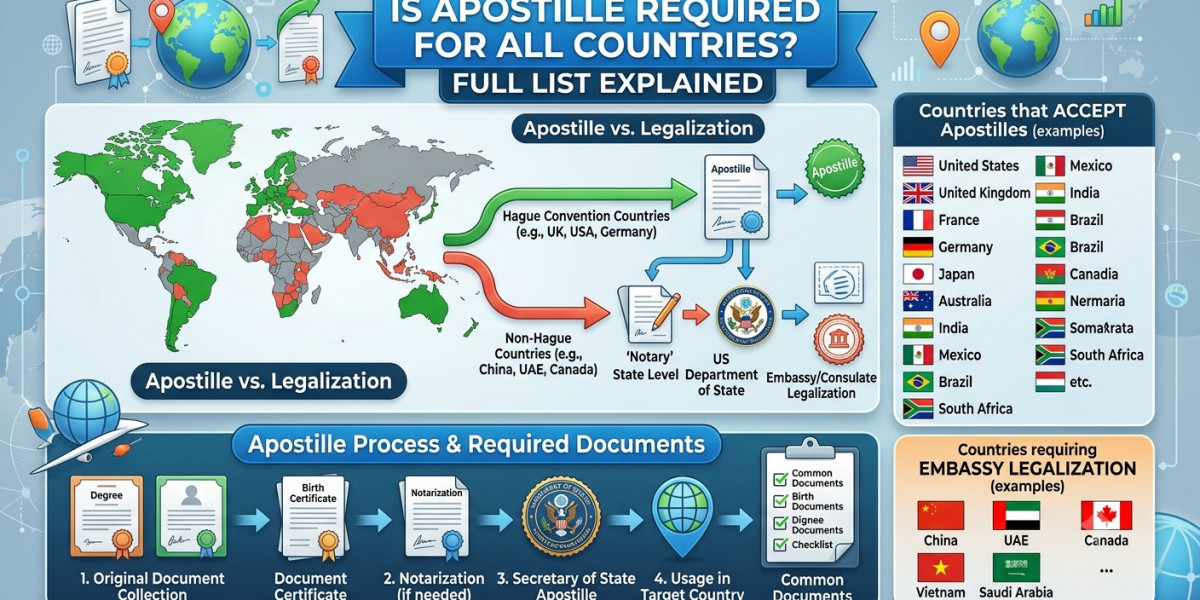

If you are planning to study, work, get married, start a business, or settle abroad, one of the first questions you may have is "Is apostille required for all countries?" The answer is No. Whether your documents require an apostille or embassy attestation depends entirely on the destination country's international agreements. At Secure Apostille Services Hyderabad, we help individuals and businesses understand the correct legalization process so their documents are accepted without delays or rejection.
Many applicants assume that every country accepts apostilled documents, but that is not the case. Some countries recognize apostilles issued under the Hague Convention, while others require embassy legalization after authentication by the Ministry of External Affairs (MEA). Understanding this difference before submitting your documents can save valuable time, money, and unnecessary complications.
What Is an Apostille?
An apostille is an international certificate issued by the Ministry of External Affairs (MEA) in India that verifies the authenticity of a public document. It confirms that the signatures, seals, and stamps on a document are genuine and legally recognized.
Once a document receives an apostille, it is generally accepted by countries that are members of the Hague Apostille Convention without requiring further embassy legalization.
Documents commonly apostilled include:
- Birth Certificates
- Marriage Certificates
- Degree Certificates
- Diploma Certificates
- Police Clearance Certificates (PCC)
- Death Certificates
- Affidavits
- Power of Attorney
- Commercial Documents
Is Apostille Required for All Countries?
No. Apostille is accepted only by countries that have signed the Hague Convention of 1961.
Countries that are not members of the convention require a different legalization process known as Embassy Attestation or Consular Legalization.
Therefore, before beginning document authentication, it is essential to verify the destination country's requirements.
What Are Hague Convention Countries?
The Hague Convention Abolishing the Requirement of Legalisation for Foreign Public Documents was established in 1961 to simplify document legalization between participating countries.
Today, more than 125 countries recognize apostilled documents.
Some of the most common Hague Convention countries include:
- Germany
- France
- Italy
- Netherlands
- Spain
- Portugal
- Belgium
- Australia
- New Zealand
- Japan
- South Korea
- United States
- United Kingdom
- Ireland
- Switzerland
- Poland
- Sweden
- Norway
- Finland
- Denmark
When documents are intended for these countries, an apostille issued by the Ministry of External Affairs is generally sufficient.
Countries That Do Not Accept Apostille
Several countries are not members of the Hague Convention and therefore require Embassy Attestation instead of an apostille.
Examples include:
- United Arab Emirates (UAE)
- Qatar
- Kuwait
- Saudi Arabia
- China
- Vietnam
- Malaysia
- Thailand
- Indonesia
- Egypt
For these destinations, documents usually undergo:
- State Authentication
- Ministry of External Affairs Authentication
- Embassy Attestation
- Sometimes Ministry of Foreign Affairs (MOFA) attestation after arrival
Apostille vs Embassy Attestation
Although both procedures authenticate documents for international use, they are different.
Apostille
- Accepted by Hague Convention countries
- Issued by the Ministry of External Affairs
- No embassy legalization required
- Faster process
- Lower overall cost
Embassy Attestation
- Required for non-Hague countries
- Includes Embassy or Consulate verification
- Additional authentication stages
- Usually takes more time
- Costs more due to multiple authorities involved
Choosing the correct process depends entirely on the country where the document will be used.
Which Documents Can Be Apostilled?
The Ministry of External Affairs can apostille various categories of documents.
Personal Documents
- Birth Certificate
- Marriage Certificate
- Divorce Certificate
- Death Certificate
- Police Clearance Certificate
- Medical Certificate
- Affidavits
Educational Documents
- Degree Certificate
- Diploma Certificate
- Mark Sheets
- Transcripts
- School Certificates
Commercial Documents
- Certificate of Incorporation
- GST Certificate
- Board Resolution
- Power of Attorney
- Memorandum of Association
- Articles of Association
- Export Documents
- Commercial Invoices
Each category follows a slightly different authentication process before reaching the Ministry of External Affairs.
How Does the Apostille Process Work in India?
The document legalization process generally includes the following steps:
Step 1: Document Verification
The document is examined to determine the appropriate authentication route.
Step 2: State Authentication or SDM Verification
Depending on the document type and destination country, authentication is completed through the State Home Department, HRD, or SDM.
Step 3: Ministry of External Affairs Apostille
After successful verification, the Ministry of External Affairs issues the Apostille Certificate.
Step 4: International Acceptance
The document becomes legally acceptable in Hague Convention countries without additional embassy legalization.
How Long Does the Apostille Process Take?
Processing time depends on several factors, including:
- Document type
- Issuing state
- Verification authority
- Government workload
Generally, the process may take anywhere from a few working days to a couple of weeks. Applicants with urgent travel deadlines should begin the process well in advance.
Common Reasons Documents Get Rejected
Many applications experience delays due to avoidable mistakes.
Common reasons include:
- Incorrect personal information
- Damaged or laminated documents
- Unclear photocopies
- Missing signatures
- Name mismatch between passport and certificates
- Incomplete authentication
- Selecting the wrong legalization process
Checking every detail before submission significantly improves approval chances.
Why Professional Guidance Matters
Many applicants are unsure whether their destination country requires an apostille or embassy legalization.
Professional assistance helps:
- Identify the correct legalization route
- Prevent document rejection
- Save time
- Avoid unnecessary expenses
- Ensure compliance with international requirements
- Meet visa and immigration deadlines
This becomes especially important for education admissions, employment visas, immigration applications, overseas marriage registration, and international business transactions.
How to Verify Whether Your Country Requires Apostille
Before submitting documents, you should:
- Confirm whether the destination country is a Hague Convention member.
- Check the latest legalization requirements.
- Verify document eligibility.
- Confirm whether state authentication or SDM verification is needed.
- Ensure all information matches your passport.
Taking these precautions helps avoid delays and repeat submissions.
Conclusion
Understanding whether apostille is required depends entirely on the country where your documents will be used. Hague Convention countries accept apostilled documents issued by the Ministry of External Affairs, while non-member countries require embassy attestation. Knowing the difference before starting the process ensures faster approvals and prevents costly mistakes.
Whether you are relocating for higher education, employment, immigration, business expansion, or family settlement, obtaining the correct document legalization is essential. Secure Apostille Services provides professional guidance throughout the authentication process, helping applicants complete every step accurately and efficiently. If you need reliable assistance with document legalization, our experienced team in Hyderabad is ready to help you obtain internationally accepted documents with confidence.









