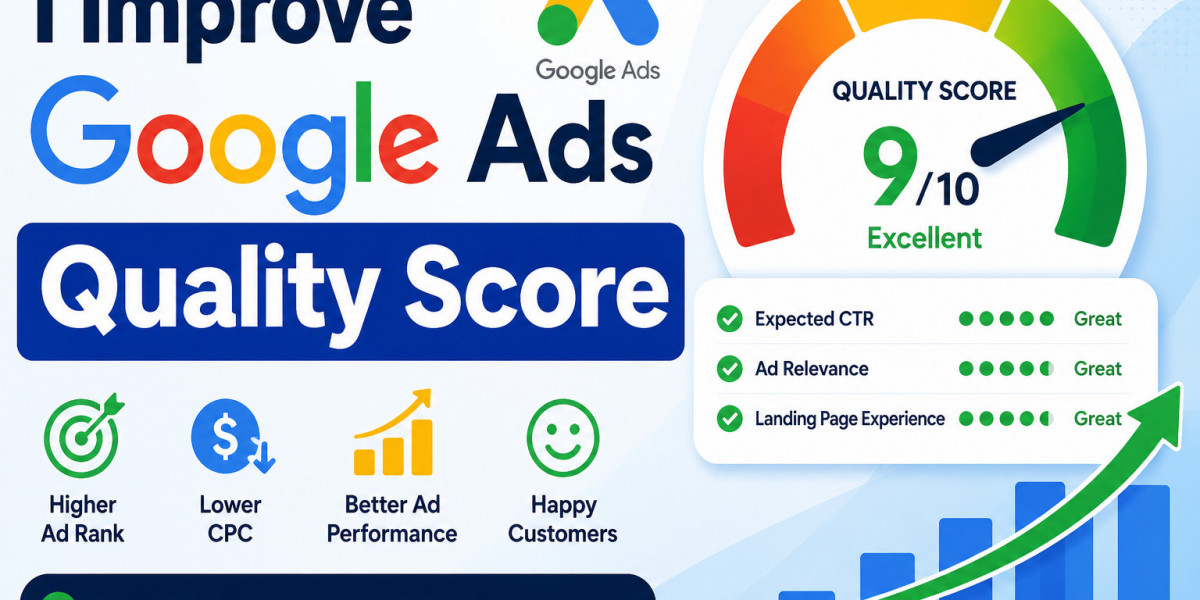

Ever opened up your Google Ads dashboard and asked yourself why your competition is paying less per click for the exact same keyword? The answer is generally one number: Quality Score. A score of 7 or more is typically regarded as excellent, implying that your ad, keywords, and landing page are relevant and beneficial compared to other marketers bidding on the same search.
Accounts with a quality score of 5 or lower generally spend 50-100% more per click than competitors with a score of 8 or above. So a poor score isn’t simply a vanity metric; it’s silently eating your cash.
The positive note is that a quality score isn't a random or strange thing once you know what feeds it. This guide will tell you what moves the needle, what to focus first, and how to restore a poor score without burning through more ad expenditure.
Why Quality Score Still Matters in 2026
Some advertisers believe Quality Score is dead because most ads are operated on automatic bidding. That's not quite right. The score does not directly go into the auction, but the same relevance signals that construct it also feed into Ad Rank, so strengthening one tends to increase the other. Google has slowly taken the quality score out of its public message, pushing marketers toward automated bidding and broader targeting—yet the signals behind it still determine how much you spend and where you show up.
It directly influences your cost per click: The higher the score, the more relevant your ad is, and Google rewards that with cheaper clicks for the same place.
It impacts your ad rank, not just your CPC: Relevance signals are used to determine ad rank (not just quality score), so poor scores might result in a lower volume of impressions.
It updates all the time: It might vary day-to-day as Google obtains new performance data on your advertising, keywords, and landing pages, so modest variations are expected.
Quality Score is a diagnosis, not a goal: Google Ads Help explains that Quality Score is a diagnostic, not a performance objective in itself.
Ignoring it costs money fast: The longer a poor score is left ignored, the more you overpay relative to rivals doing the fundamentals well.
What Factors Actually Influence Your Quality Score?
Knowing what exactly Google is measuring is useful before you start fixing things. A quality score is based on 3 factors: projected click-through rate, ad relevancy, and landing page experience. Each of them is very important, and disregarding any one of them will restrict your score no matter how good the other two are.
Expected click-through rate (CTR): Google's projection of how likely people are to click your ad when it's shown for a certain term.
Ad relevancy: The degree to which your ad copy fits the intent behind the searcher’s phrase.
Landing page experience: Improved by message match, page speed, and mobile UX—simply put, does the page offer what your ad promised?
Account & ad group structure: Tightly themed ad groups will automatically help all three of the above aspects fall into place.
Historical performance data: Google makes decisions based on how your account and keywords have performed in the past, so consistency over time is just as important as any one change.
Step-by-Step Ways to Improve Your Quality Score
This is the practical element, the real modifications that improve google ads quality score:
Tighten Your Ad Group Keyword Structure
One ad group = one clear objective. You can't write ad content that is tightly relevant to all of them at once, and Google sees that when you jam unrelated keywords in one ad group. Often one of the quickest ways to improve your ad relevance ratings is to break big ad groups into smaller strongly related ad groups.
Match Search Intent in Your Ad Wording
Ad relevancy is better when keywords are more closely aligned with ad groups. This means your headlines and descriptions should use the real language customers are using in their searches, not generic brand messages. By testing several responsive search ad versions and halting weak performers, predicted CTR will increase with time.
Fix Your Landing Page Experience
You may enhance the landing page experience with message match, page speed, and mobile UX. If somebody clicks on an ad saying you get a discount and they get to a generic webpage, that mismatch harms you. Ensure that the website title, offer, and content match what the ad promised, and make sure it loads quickly on mobile, where most clicks happen.
Increase Projected CTR Using Ad Extensions
Writing higher-CTR responsive advertising generally boils down to offering searchers more reasons to click. Sitelinks, callouts, and structured snippets all contribute real estate and relevancy signals at no extra cost per click.
Be Patient and Keep Iterating
You may progressively improve predicted CTR and ad relevance to help increase a keyword’s quality score, but there’s no quick reset. This means ongoing testing is more beneficial than one large overhaul; little, steady gains add up over weeks, not days.
Common Mistakes That Are Quietly Hurting Your Quality Score
Even the most basic fundamentals of advertising can be ruined by those who don't know it. Before you begin troubleshooting, check to see if any of these common tendencies are sabotaging you.
Mixing unrelated terms in one ad group: This is the most typical error, and it breaks everything. If you have one ad group targeting five distinct intents, there’s no way your ad content can remain relevant to all of them, and your score decreases across the board, even if your landing site is great.
Sending every click to the same landing page: Using one generic site for all your advertisements could reduce setup time, but it violates the message match Google is searching for. Distinct keywords require distinct, customized landing pages.
Ignoring mobile performance: A landing page that loads well on desktop but crawls on mobile may quietly destroy your landing page experience score. Particularly when most search traffic now originates from phones.
Chasing the score instead of the basics: Some advertisers focus on the number without altering the actual ad language, structure, or page experience behind it. The score is a symptom, not the sickness—cure the causes, and the number will follow.
Expect immediate effects from one huge change? : Quality Score adjusts gradually as Google acquires fresh data. You can't expect results after one overhaul, and the most common and easiest error is to give up too soon on a very excellent patch.
Not testing ads: If you’re running the same ad wording for months at a time without testing fresh versions, you’re leaving predicted CTR increases on the table. Regular testing allows your account to grow instead of stagnate.
Avoiding these traps may be just as important as actively improving; sometimes the quickest way to boost your score is to just stop performing the things that are bringing it down.
End note!
It’s not about hitting a number to get a better quality score; it’s about making your keywords, advertising, and landing pages really align with what people are searching for. Start with structure, since when your ad group is a disaster, everything else is tougher to improve. From there, tighten up your content, tidy up your landing pages, and give it time; scores increase gradually, not overnight. Get these basics correctly, and decreased expenses will often come naturally.